
As published on the Canadian Urban Forest Network Exchange, April 27, 2026.
By Adrina C. Bardekjian, Kim Statham, Danijela Puric-Mladenovic, Kayleigh Hutt-Taylor
What does it mean to connect research and practice?
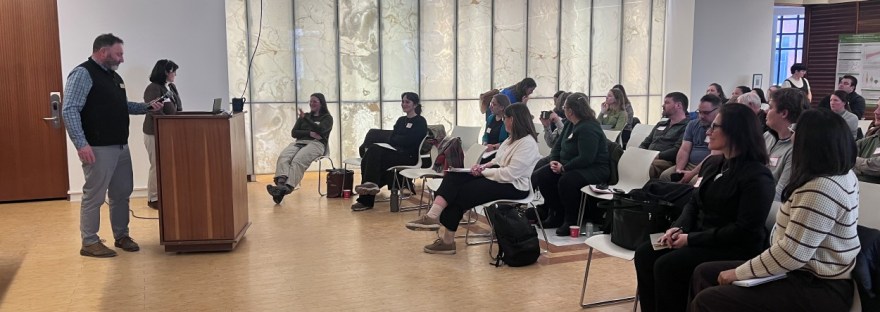
In January, the Canadian Urban Forest Network (CUFN) Ontario region workshop, “Connecting Research and Practice for Urban Woodland Management,” brought together researchers, practitioners, and decision-makers working across urban and peri-urban Southern Ontario. Discussion focused on urban pressures, invasive species, changing environmental conditions and the importance of monitoring. The workshop questioned how to best manage woodlands and implement conservation strategies that preserve these vital urban ecosystems.
Urban woodlands are areas of forested land within or near cities that connect natural and built environments. They exist at the intersection of ecology, infrastructure, and community use. Managing them well requires more than data or policy alone: it requires trust and sustained relationships among all stakeholders. Throughout the day, keynote speakers, panelists, and participants answered the question: how do we ensure that research meaningfully informs practice, while allowing on-the-ground experience and the relationship between colonialism and conservation to shape research questions in return?
The workshop didn’t pretend there were easy answers. Instead, it modeled a willingness to sit together in complexity.
Are we brave enough to question what we think we know?
One of the most resonant themes was the importance of long-term monitoring and adaptive management, paired with a critical lens on “common” or inherited practices. In urban woodland management, habits can calcify quickly – sometimes because they once worked, sometimes because there hasn’t been space or capacity to challenge them. The panel, including perspectives from practitioners and researchers from southern Ontario municipalities, Maitland Valley Conservation Authority and University of Toronto emphasized the importance of:
• Strategic monitoring and regular assessments in urban woodlands.
• Trial and error approaches to invasive species management.
• Challenges of urban forest management within changing political environments.
• Building trust with landowners.
Following this, the group discussed the spread and management of invasive species in urban woodlands. Monitoring results show invasive spread across these areas. In response, management is two-fold: to prioritize protecting high-quality sites and managing the invasion. To hinder invasion and support forest regeneration, site-specific management methods, including community and volunteer efforts, were highlighted as important for controlling the spread.
Keynote speaker Ted Wilson compared the highly fragmented UK landscape to that of Southern Ontario and underlined the importance including diverse stakeholders in management and monitoring. He stated, if multiple structures who care about the forest for different reasons want to take care of it, the result is a diverse and resilient forest that meets many different needs.
Participants benefited from both sharing successes and discussing uncertainties. They spoke honestly about gaps in knowledge, competing priorities, and the limits of current tools. Rather than framing uncertainty as a weakness, the workshop treated it as a shared starting point. This came up rather pointedly through the first keynote address by Gary Pritchard, owner of 4Directions Conservation Consulting, on raising the notion of a “pan-Indigenous approach” in environmental stewardship, meaning the continued oversimplification of Indigenous People’s, identity, culture, language, history and needs in Canada.
This created room for thoughtful questions, respectful disagreement, and learning without judgment. It was a reminder that progress in complex systems often begins not with confidence, but with curiosity.
What becomes possible when we make space for discomfort and for each other?
The workshop brought together people from the City of Toronto Urban Forestry, the University of Toronto’s John H. Daniels Faculty of Architecture, Landscape, and Design (Institute of Forestry), and Tree Canada. It offered a space to share ideas, listen across disciplines, and explore collaboration beyond institutional boundaries. The day showed that meaningful change involves some discomfort, and that successful gatherings rely on both expertise and careful planning. By the end, participants left with not only new insights but also a sense of shared commitment to urban forest management and the relationships that support it.
The conversation doesn’t end here. It continues online, in practice, and in the questions we carry forward together.
Join the CUFN Exchange: https://cufn-exchange.treecanada.ca/member-home/


